
Explore the Green Sky Landscapes blog for expert Byron Bay landscaping tips, garden design ideas, coastal planting advice, water features, paving inspiration and more. Practical guides from your local Byron Shire landscapers to help create your dream outdoor space
Blog
Fire Pit Ideas for Byron Shire Backyards: Building a Space That Actually Gets Used
A fire pit isn't a feature you add to a garden — it's the reason people stay outside after dark. Two real builds, two very different styles.
A fire pit isn't a feature you add to a garden. Done properly, it's the reason people are still outside at 9pm instead of back on the couch.
Most backyards in the Northern Rivers get used in daylight and forgotten after 6pm. Fire pit ideas that actually work start with construction, not decoration — set in place, sized correctly, with seating designed around it from the start, so evening use is the plan, not an accident.
This guide covers two real approaches we've built for homeowners across Byron Shire and the Northern Rivers — one rustic, one Mediterranean — plus the practical things worth knowing before you commit to one: cost drivers, council requirements, and how to choose the style that fits your home. Done right, a fire pit becomes the natural focal point of a backyard and stretches outdoor living well past summer, into the cooler months when most gardens go quiet.
Start With the Question: What Does This Space Need After Dark?
That's the brief every time. Not "where do we put a fire pit," but what the whole space needs to work once the sun's down — fire pit, seating, paving, lighting, all positioned outward from the same centre point.
We took that approach on a recent project in Banora Point — a backyard with good bones but no real purpose after dark. Fire pit first. Everything else built around it.
Rustic — Banora Point
Built In Place
A custom-built fire pit is constructed with the correct dimensions for heat output and airflow, set into the ground properly, built to be used hard for years. Made for the space, not placed in it.
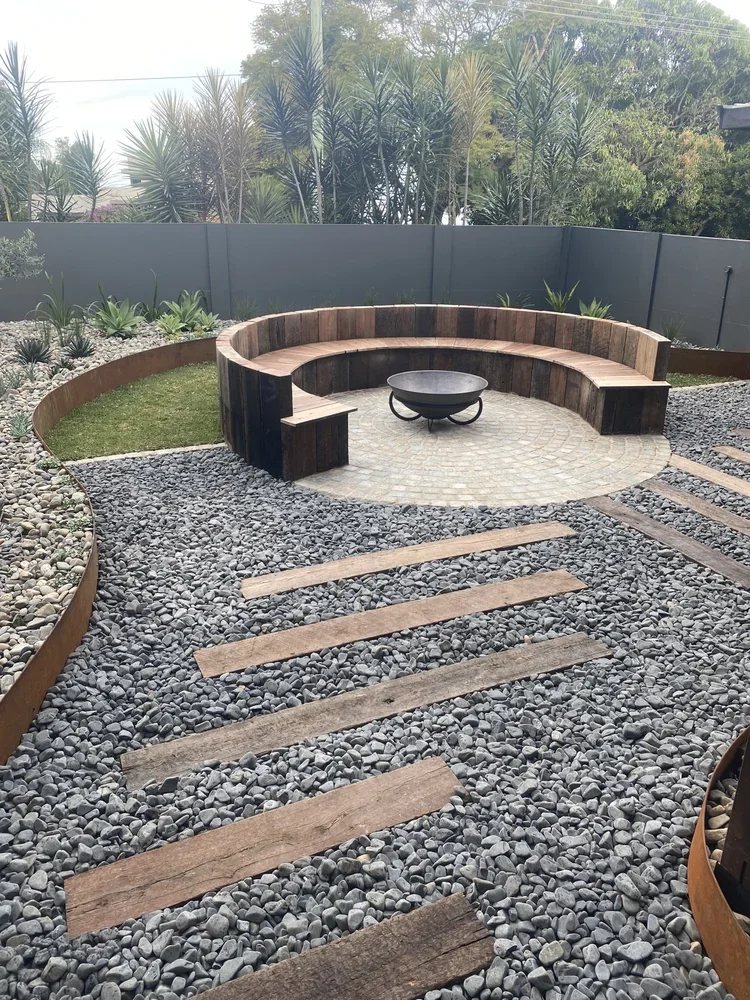
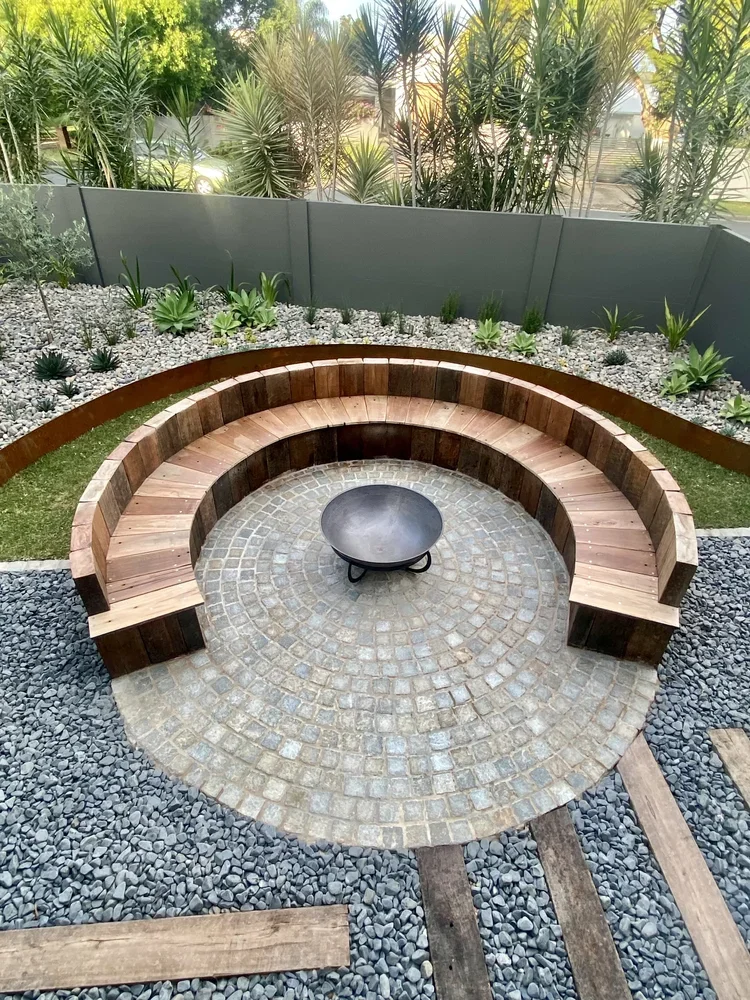
At Banora Point, the fire pit area sits inside a cobblestone circle on a prepared, compacted base — tight-jointed, tough enough for direct fire heat, foot traffic and Northern Rivers weather. No sealing, no ongoing maintenance, no shifting.
Why a Circle, Not a Square
A circular layout solves what straight lines can't: every seat faces the fire, nobody's stuck at the wrong angle or the end of a bench. It also makes the fire pit the clear focal point of the space rather than one feature competing with others. The curve softens the materials too — cobblestone and heavy timber are hard and textural, and the circle stops the space feeling rigid.
Seating Built Into the Design
The fire pit seating here is recycled railway sleepers — dense, pressure-treated hardwood already proven over decades of rail use. Curved into a bench and bedded into the ground, it won't move, and it brings a weight nothing bought new can match. It's one of the simplest fire pit seating ideas there is: use a material that's already tough, and let it do the work. The same sleepers reappear as a path and low edging, tying the whole outdoor living space together.
The Details That Make It Last
Corten steel edging — rusts to a deep, warm patina within months and forms a stable, protective finish. It holds garden bed lines clean against the cobblestone and gets better looking the older it gets.
Textural planting — planted close in around the fire pit and paving so the hard materials have something soft to sit against, without ever competing with them for attention.
Subtle night lighting — low, warm, and positioned to work with the fire rather than compete with it, so the space still feels like it's lit by flame even once the sun's fully gone.
Together, these are the difference between a fire pit space that looks considered and one that looks like an afterthought.
Mediterranean — Lennox Head
Where Banora Point is raw and rustic — sleepers, cobblestone, weathered materials — this one is refined and Mediterranean. Same brief, same fire-first thinking, different material language entirely.
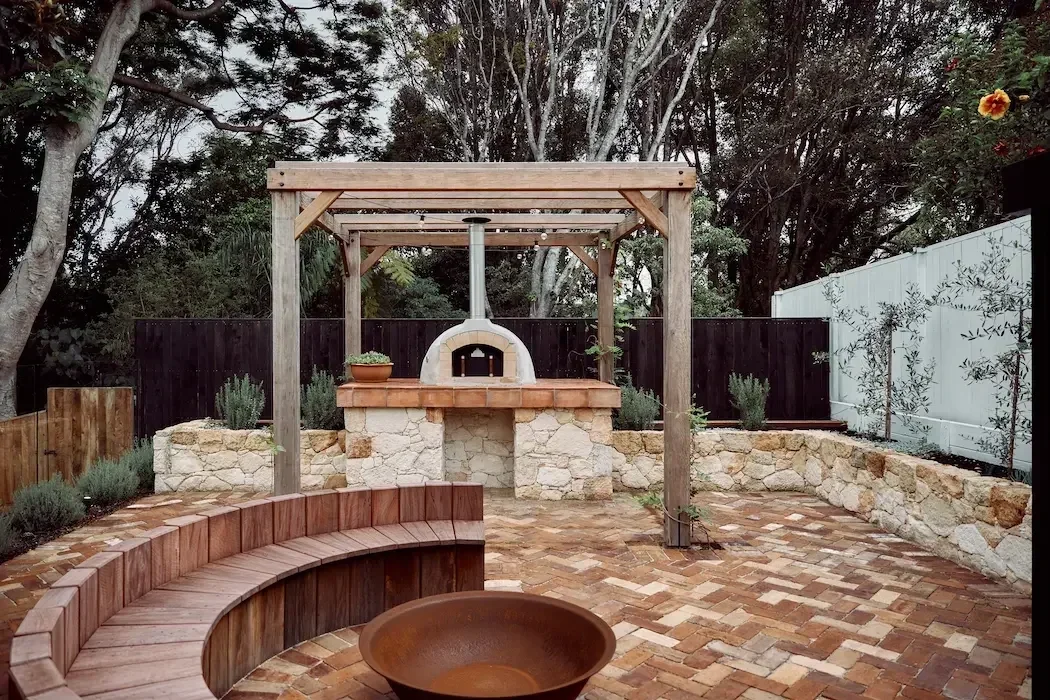
The fire feature is built from milled red ironbark slabs, 200mm x 100mm, set vertically in a semi-circle, with matching milled ironbark bench seating following the same curve. Same logic as Banora Point — every seat faces the fire, nobody's at the wrong angle — just executed in a material that reads warmer and more refined than raw sleepers.
Underfoot, recycled brick paving ties the space together. Around the edges, rosemary, lavender and olive trees do the rest — low, aromatic, textural planting that's genuinely low-maintenance once established, and about as close to the real Mediterranean as this climate allows.
This one goes further than a fire pit alone: a limestone-clad outdoor kitchen with a wood-fired pizza oven and a terracotta bench sits under a hardwood arbor, turning fire pit seating into a full outdoor living destination rather than a single feature.
Small Outdoor Spaces Work Just as Well — Sometimes Better
Treating a compact backyard as a limitation is the biggest mistake people make. A small outdoor space with one clear purpose — built entirely around evening use, fire pit at the centre — will outperform a larger yard with no focus every time.
Rustic or Mediterranean — Fire Pit Design Ideas to Suit Your Space
Timber and stone against a coastal or bushland block tends to suit the rustic direction. Rendered or Mediterranean-style homes, or gardens already leaning toward olive, lavender and terracotta tones, suit the second. Either way: build the fire pit first, then design everything else — seating, paving, planting, lighting — around it.
Before You Build
A fire pit is permanent, so a few things get settled at the design stage rather than worked out on the fly.
Safety Clearances
Distance from fences, overhanging trees and the house determines where the fire pit can actually go — it's the first thing that shapes the layout, before anything else gets designed around it.
Drainage
The base needs to shed water properly, built into a compacted, well-drained foundation from the start.
Council Requirements
Byron Shire and Tweed Shire have their own requirements around permanent outdoor fire features, and NSW total fire bans affect when a wood-burning fire pit can be used, regardless of what's approved. Both are worth knowing early if year-round use matters to you.
Fuel Type
Wood and gas are built differently — wood needs airflow and smoke clearance, gas needs a line run to the fire pit and different underfloor work. Deciding early keeps the build straightforward.
We work through all four with you at the design stage, so the fire pit you end up with is the one you actually planned for.
What This Kind of Space Actually Costs
Three things drive price: the diameter of the fire pit and seating circle, the total length of seating (four-person curve versus a wraparound bench for eight), and whether lighting and planting are part of the same build. Scope drives cost more than material choice — a compact rustic setup like Banora Point sits at a different price point to a full Mediterranean zone with an outdoor kitchen and arbor.
As a rough guide, projects of this scale in the Northern Rivers represent strong long-term value, because the materials and construction methods used won't need replacing or repairing in a few years. That's the whole point of building it properly the first time.
Frequently Asked Questions
-
It depends on scope — the diameter of the fire pit and seating circle, the total length of seating, and whether lighting and planting are part of the same build. A compact rustic setup like Banora Point sits at a different price point to a full Mediterranean zone with an outdoor kitchen and arbor. The best way to know is a site visit and a proper quote.n text goes here
-
It depends on the size, fuel type and location relative to boundaries and structures — some permanent fire features need approval, others don't. We check this as part of the design process, before anything's built, so there are no surprises later.
-
A standalone fire pit and seating area, like Banora Point, typically takes one to two weeks depending on site access and weather. A full outdoor living zone with paving, planting and a kitchen — closer to the Lennox Head scope — runs longer.
-
Yes, though it depends on what's already there. Adding a fire pit after the fact means working around existing paving, drainage and garden beds rather than designing them together from the start — still very achievable, just a different process to a new build.
-
A fire pit is open, low, and built for gathering around — seating faces inward, and it works as the centre of a space. An outdoor fireplace is vertical, usually against a wall or structure, and works more as a backdrop feature than a gathering point. Both have their place; it comes down to how you want people to sit and move around the fire.
Want a fire pit like one of these in your own backyard?
Contact us and let's talk about what fits your space.
Or see the full projects first: Rustic Fire Pit Banora Point and Mediterranean Outdoor Living, Lennox Head